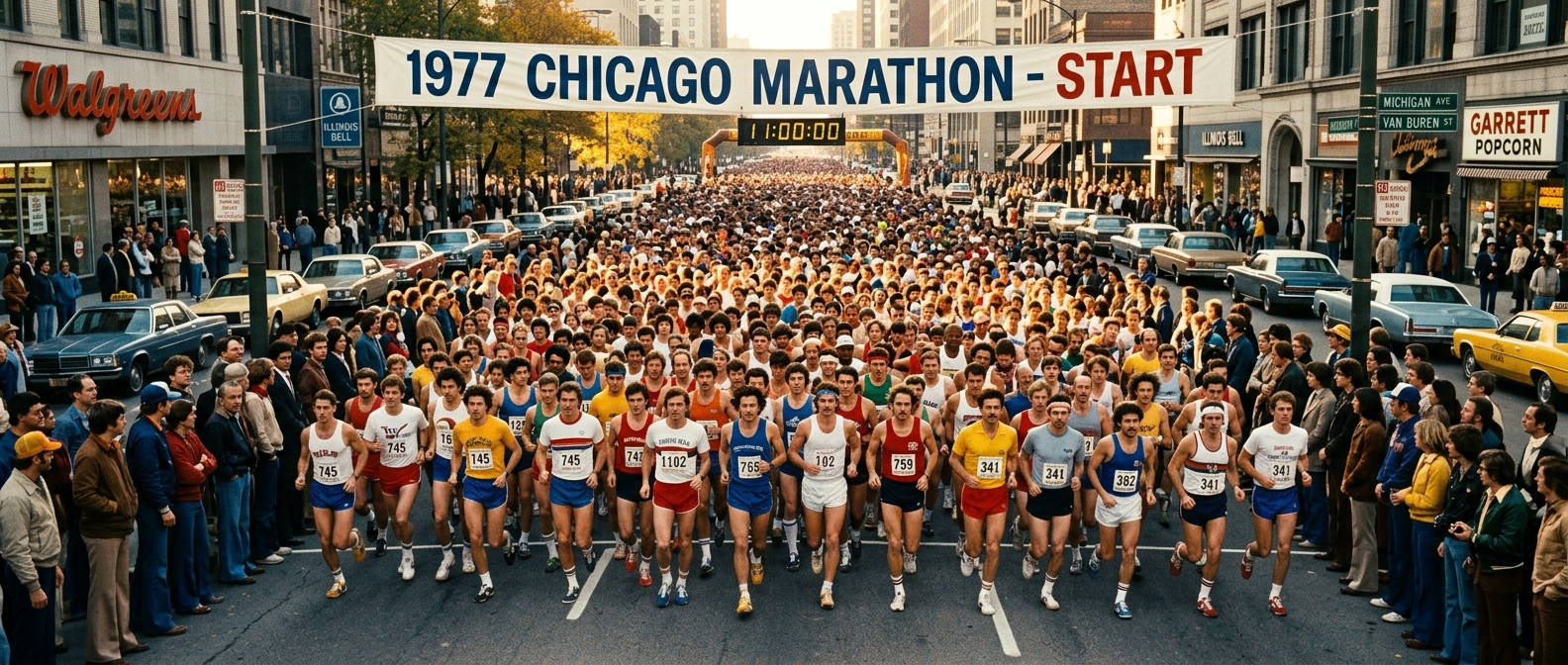
4,200 Strangers and a Starting Gun
On September 25, 1977, the city of Chicago fired a starting gun for the very first time in what would become one of the most iconic road races on the planet. About 4,200 people showed up — not because the Chicago Marathon was famous, not because it had a legacy, and not because finishing it meant anything to the outside world yet. They showed up because someone decided to start the thing, and enough people thought, "yeah, I'll try that." That's it. That's the whole origin story.
There's something deeply relevant about that moment for anyone building software, launching a product, or trying to grow a business. The Chicago Marathon didn't become a world-class event by planning for 45,000 participants on day one. It became world-class by actually happening — messy, modest, and real. Version 1.0 of anything rarely looks like the polished thing you imagine at 2am. But the 4,200 people who ran that first race in 1977 created the proof of concept that made every future race possible. You can't iterate on something that never launched.
The other thing worth sitting with: those 4,200 runners had no guaranteed outcome. No one knew if the route would be well-organized, if the city would embrace it, or if anyone would even care. They signed up anyway. In tech, we spend enormous energy trying to eliminate uncertainty before we ship — more planning, more testing, more alignment. Some of that is wisdom. But some of it is just fear dressed up as professionalism. The people who built something lasting in Chicago didn't wait until it was perfect. They laced up, showed up, and let the race teach them what to fix next year.