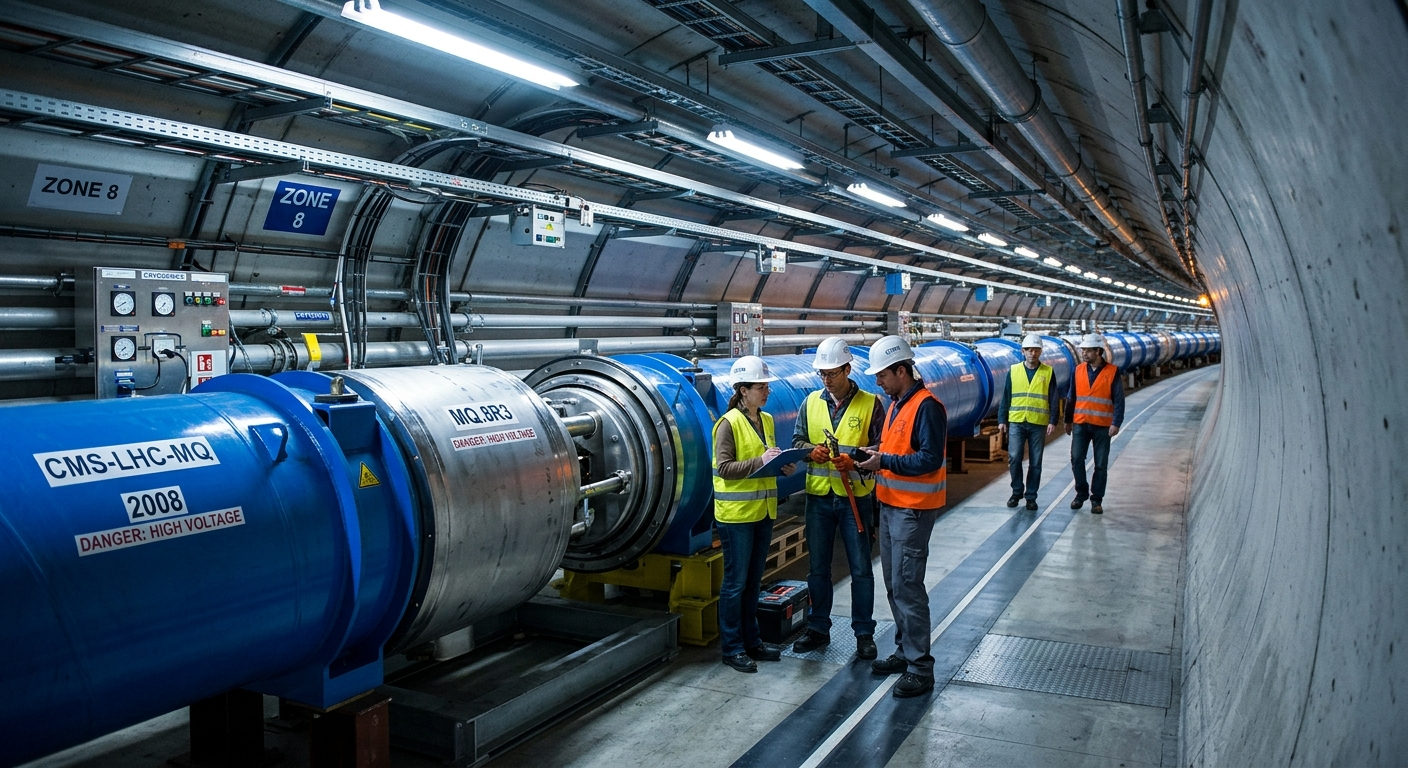
The Big Bang Button: What the LHC's 2008 Power-Up Teaches Us About Betting on Big Ideas
On September 10, 2008, a team of thousands of scientists from over 100 countries gathered around screens and control rooms in Geneva, Switzerland, and did something that took 25 years and roughly $4.75 billion to make possible: they powered up the Large Hadron Collider for the first time. The world's largest and most powerful particle accelerator — a 17-mile ring buried 300 feet underground — was finally switched on. Some people genuinely feared it would create a black hole and end the world. Spoiler: it didn't. What it did do was eventually confirm the existence of the Higgs boson in 2012, a particle that had been theorized since 1964. Nearly five decades from idea to proof. That's a long sprint.
Here's what strikes me about the LHC story from a tech and business perspective: nobody involved could guarantee a return on investment. There was no product-market fit slide deck. There was no 18-month roadmap to "finding the God particle." There was just a deep, collective conviction that asking the right question — what gives matter its mass? — was worth an almost incomprehensible commitment of time, money, and human effort. In software and consulting, we're constantly pressured to show immediate value, quick wins, and measurable ROI by Q3. And those things matter! But the LHC is a good reminder that some of the most important work looks completely unreasonable on paper until the moment it isn't.
The other thing worth carrying with you from September 10, 2008 is this: that power-up was not a solo act. Thousands of engineers, physicists, technicians, and project managers across dozens of countries had to coordinate, compromise, and build trust over decades. No single genius flipped a switch. The breakthrough was infrastructural — built on collaboration, standards, and shared tooling (the web itself was actually invented at CERN as a byproduct of scientists needing to share data). Whatever you're building right now, don't underestimate the unsexy work: the documentation, the communication, the alignment. That's the tunnel. The discovery comes later.