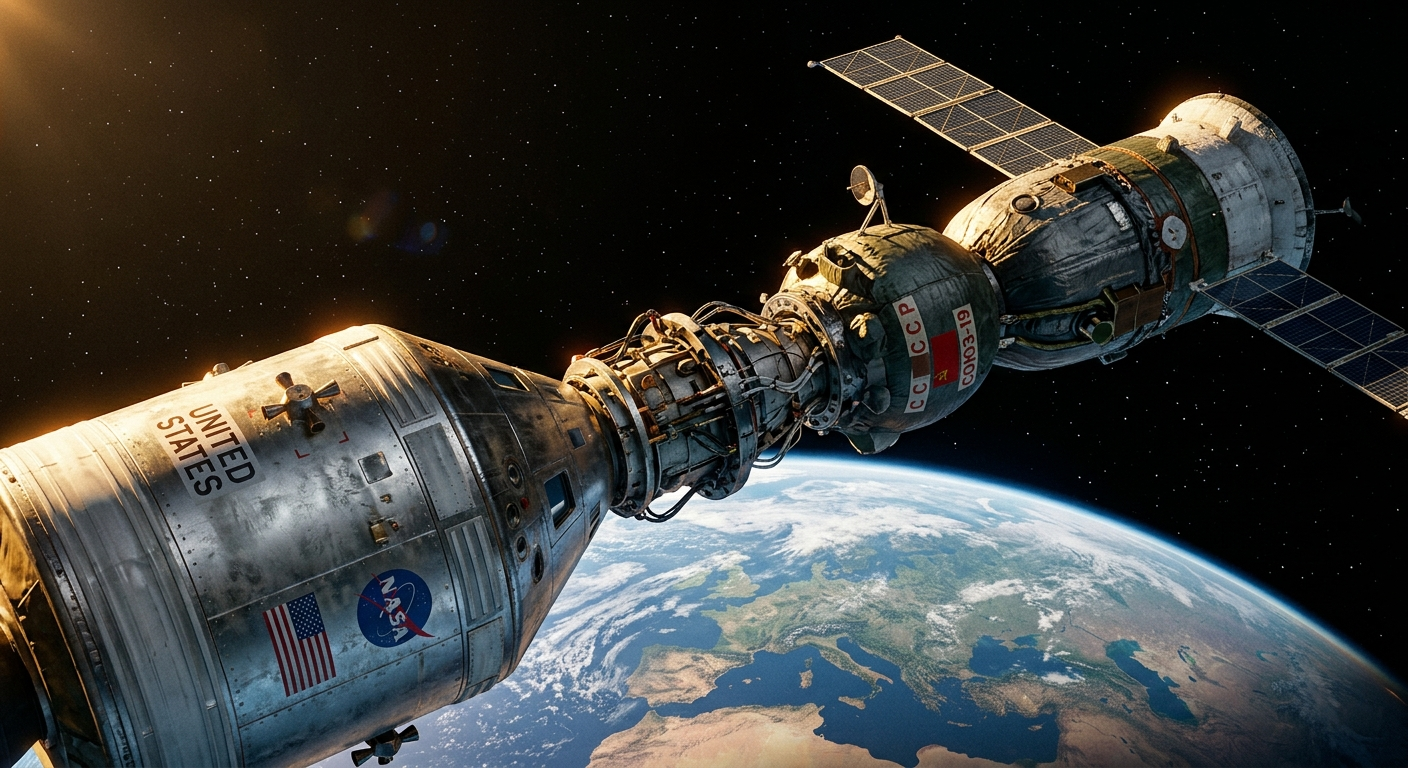
Two Nations, One Handshake in Space: What Apollo-Soyuz Teaches Us About Collaboration
On July 17, 1975, something happened roughly 140 miles above the Earth that would have seemed completely impossible just a decade earlier. An American Apollo capsule and a Soviet Soyuz spacecraft gently locked together in orbit — crews from two nations that had spent years pointing nuclear weapons at each other, now sharing a meal and a handshake in zero gravity. The Apollo-Soyuz Test Project wasn't just a feel-good moment. It was an engineering achievement that required both teams to literally redesign their docking systems from scratch so two fundamentally incompatible spacecraft could connect.
That engineering problem is one most of us in tech know intimately. How many times have you inherited a legacy codebase that needs to talk to a shiny new system? How often do you bring in a new vendor, a new API, or a new team — and suddenly realize everyone built their "spacecraft" using completely different assumptions? The Apollo-Soyuz crews didn't complain that the other side built it wrong. They built an adapter. A purpose-built docking module that bridged the gap between two different atmospheric pressures, two different designs, two different worldviews. That's the job. That's leadership.
The bigger lesson here is about what becomes possible when you stop treating incompatibility as a dealbreaker. In 1975, the Cold War was very much still on. Trust was thin. The stakes were enormous. And yet engineers and mission controllers on both sides figured it out — through meticulous documentation, shared protocols, and a willingness to meet in the middle. If you're navigating a messy integration project, a difficult client relationship, or a team that can't seem to speak the same language, remember: two of the most technologically proud organizations in human history swallowed their pride, built an adapter, and shook hands in space. You can probably get through your sprint planning.