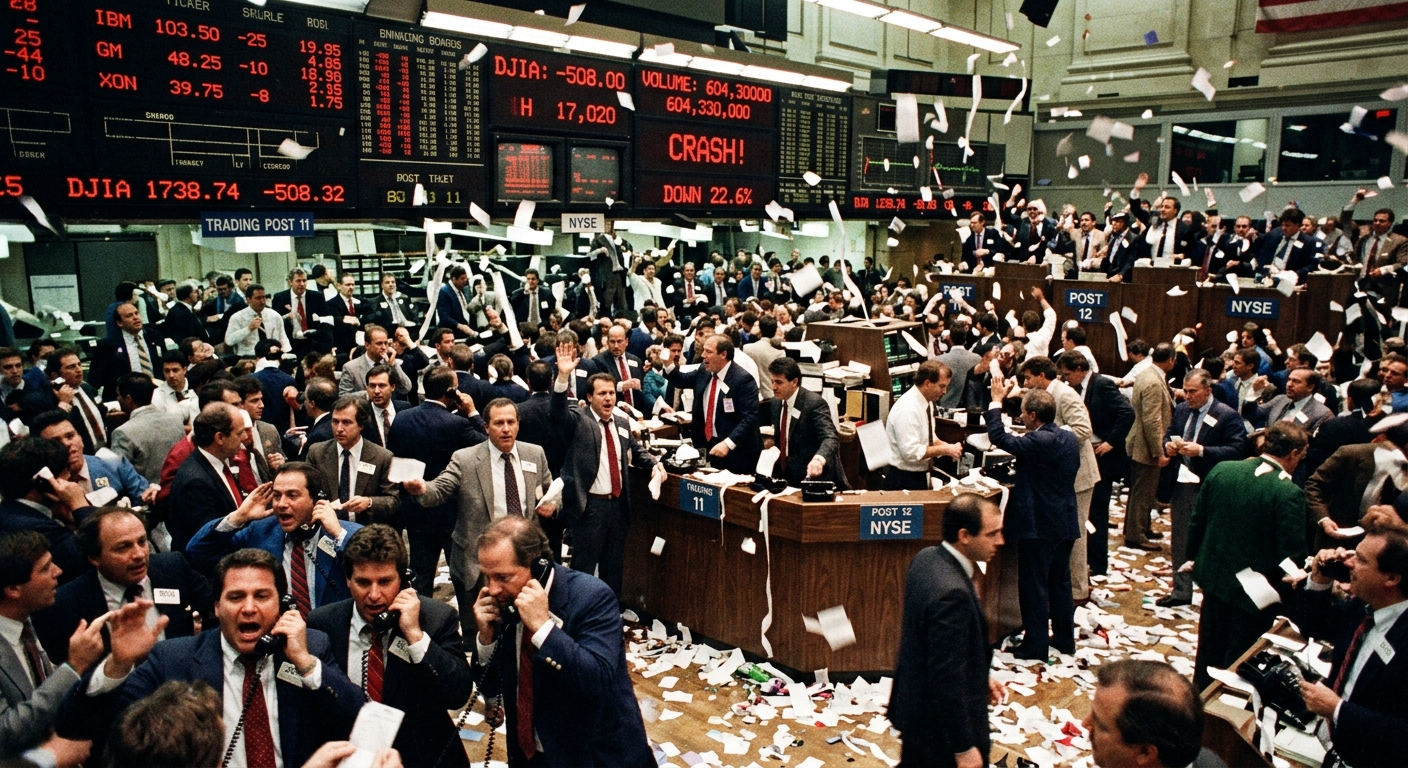
The Day the Dow Fell Off a Cliff
On October 19, 1987, the Dow Jones Industrial Average dropped 508 points—a staggering 22% in a single trading session. To put that in perspective, that's still the largest single-day percentage loss in Wall Street history, dwarfing even the crashes of 1929 and 2008. Traders on the floor of the NYSE described it as pure chaos. Nobody had a playbook for it. The systems—both human and technological—were overwhelmed, and for a few terrifying hours, nobody really knew where the bottom was.
Here's the part that doesn't get talked about enough: the market didn't just survive Black Monday, it learned from it. Circuit breakers were introduced. Risk models were rebuilt from scratch. Automated trading systems got guardrails. What looked like a catastrophic failure became the forcing function for building something far more robust. The crash didn't break the financial system—it exposed the gaps that were already there, and that exposure turned out to be exactly what was needed to fix them.
That's a pattern worth carrying into your own work. Whether you're managing a software deployment, leading a team through a failed product launch, or watching a key client relationship fall apart—the crash itself rarely defines you. What you do with the rubble does. The best engineering teams I've seen treat a production outage the same way markets treated Black Monday: not as something to bury in a post-mortem nobody reads, but as a genuine invitation to redesign. If your systems—technical or organizational—haven't been stress-tested yet, it's not because you're doing everything right. It might just mean the stress hasn't arrived yet. Build like it's coming.